
VCSQI Summer Quarterly Meeting Recap
The VCSQI Summer Quarterly Meeting brought members together for an evening focused on strategy, data, and practical best practices that can be translated into measurable improvement. The meeting reinforced a central theme: quality improvement is not just about tracking outcomes; it is about using data, collaboration, and shared learning to improve patient care, strengthen systems, and demonstrate value.
The program opened with a review of VCSQI’s mission to transform cardiovascular care, improve patient experience and value, and optimize heart care outcomes through collaboration, innovation, and research. Members were also reminded that up to two CME hours were available for physicians, nurses, and physician assistants, with instructions provided for claiming credit through the UVA CME Village.
Board and Strategic Highlights

A key update centered on VCSQI’s continued work to define and communicate its value proposition. Dr. Peter O’Brien, VCSQI Vice Chair (Centra Lynchburg), emphasized the growing need for quality leaders to be able to clearly explain the return on investment of quality work, especially as health systems face tighter financial pressures. The discussion made a strong case that preventing complications is not only clinically and ethically important, but also financially meaningful. Examples shared included the estimated cost impact of post-PCI acute kidney injury, post-PCI bleeding, and post-CABG reoperation.
Sherri White, Chief of Quality and Operations, reviewed the 2026 strategic priorities, which include advancing the organization’s data analytics infrastructure, strengthening protocol implementation and measurable outcomes, increasing member engagement, and demonstrating value through data, research, and collaboration. Current scorecard progress was shared across quality, engagement, data analytics, and value demonstration, with the goal of reaching full completion across these priority areas by year-end.

Cost and Quality Data Review
Eddie Fonner, Executive Director/Chief, Data Analytics, led a review of VCSQI’s quality and outcomes data across four key registries: CathPCI, the combined STEMI registry, STS Adult Cardiac Surgery, and STS/ACC TVT. Quarterly volume remains steady, with approximately 7,000 to 8,000 patients entering the database each quarter. The review also noted possible upward movement in TAVR cases and a potential increase in STEMI episodes, both areas that may warrant continued monitoring.

Several measures stood out during the data review. Radial access rates remain higher across VCSQI than national ACC benchmarks, but there is still considerable variation among member centers. Same-day discharge after elective PCI also showed meaningful variation, especially as more elective procedures shift toward ambulatory settings. Acute kidney injury remains an area for continued attention, with VCSQI rates noted as slightly higher than the national average and existing AKI guidelines available to members as a resource.
The STEMI data also reflected both progress and opportunity. Median door-to-balloon time across VCSQI centers was approximately 59 minutes, while first medical contact to device activation was approximately 73 minutes. Dr. O’Brien noted that this reflects meaningful progress compared with earlier years, while also emphasizing the importance of recruiting additional PCI centers across Virginia to strengthen statewide participation and improvement.

Best Practice Presentation: Reducing Post-CABG Atrial Fibrillation

Dr. Dimitrios Pousios of UVA Health/Riverside Regional Medical Center presented a compelling quality improvement initiative focused on post-CABG atrial fibrillation prevention. His team implemented a pharmaco-surgical protocol based on the Mass General PAPA Protocol, combining posterior pericardiotomy with prophylactic amiodarone. The project addressed a well-known and clinically important issue, as postoperative atrial fibrillation can increase stroke risk, mortality risk, length of stay, anticoagulation burden, and downstream patient complications.
The results were impressive. Riverside’s post-CABG atrial fibrillation rate decreased from approximately 43% to 23.8% after implementation of the protocol, with an estimated number needed to treat of five to six operations to prevent one case of atrial fibrillation. The team also saw a statistically significant reduction in the number of patients discharged on anticoagulation, along with reductions in ICU length of stay and overall hospital stay, though the length-of-stay findings were not statistically significant.
A major lesson from this work was the importance of protocol fidelity. When both components of the protocol were applied, the atrial fibrillation rate was 21%, compared with 33% when the full protocol was not completed. Dr. Pousios was direct about the real-world challenges: implementation required team consensus, reliable data capture, attention to
workflow, an amiodarone order set, and continued reinforcement with ICU and surgical staff.
The discussion that followed highlighted the potential mechanism of posterior pericardiotomy, including reducing posterior pericardial effusion and irritation near the left atrium. Dr. Pousios noted that while amiodarone contributes to the protocol, the posterior pericardiotomy may be a key driver of benefit.
Best Practice Presentation: Patient Navigation and Education in Heart Surgery
Cindi Cole and Cheryl Elkins from Centra Lynchburg presented their patient navigation and education class model for heart surgery patients. Their work focused on a simple but powerful truth: patients and families do better when they understand what is happening, what to expect, and how to participate in recovery.

Before the COVID-19 pandemic, Centra offered in-person classes for surgical patients. During the pandemic, that process shifted to individual phone calls. As surgical volume increased again, the team recognized that phone-based education was no longer efficient or sufficient, leading them to rebuild and relaunch the class model.
The class includes thoughtful operational details that reduce friction for patients and families. Patients are brought in, given lunch, and then participate in structured education. A dietitian begins the session with cardiac diet education, including sodium and cholesterol guidance, followed by a surgery-focused presentation led by the nurse navigator team. The class also reviews pre-surgery instructions, what CABG is, and pre-op and post-op education materials.
The model was inspired in part by orthopedic “joint camp” education, where patients appeared better prepared for surgery and recovery. Centra’s team adapted that concept for cardiac surgery, giving patients a clearer understanding of what to expect on the day of surgery and in the days that follow. This kind of preparation does not make open-heart surgery easy, but it does make the experience less unknown.
The impact has been seen in patient comments and workflow improvements. Patients have shared that they finally understand what they are going through, and the team has noticed fewer follow-up calls asking for repeated instructions after surgery. That matters. Fe
were avoidable calls can signal clearer education, better preparedness, and greater patient confidence.
Meeting Takeaways
The Summer Quarterly Meeting made one thing clear: improvement happens when data, discipline, and practical frontline insight come together. Continued enhancements to VCSQI’s data analytics infrastructure will strengthen the collaborative’s ability to identify opportunities, track progress, and measure impact. The post-CABG atrial fibrillation prevention work showed how evidence-based protocols can produce meaningful clinical improvement when implemented with fidelity. The Centra education model reminded us that patient experience and recovery are deeply influenced by preparation, expectation-setting, and navigation.
Together, these presentations reflected the best of VCSQI: members learning from one another, testing meaningful changes, sharing honest implementation lessons, and using data to move cardiovascular care forward.
A special thank you to Dr. Dimitrios Pousios, Cheryl Elkins, RN, Cindi Cole, RN, and all members who participated in the discussion. Your work continues to strengthen the collective impact of VCSQI across Virginia.
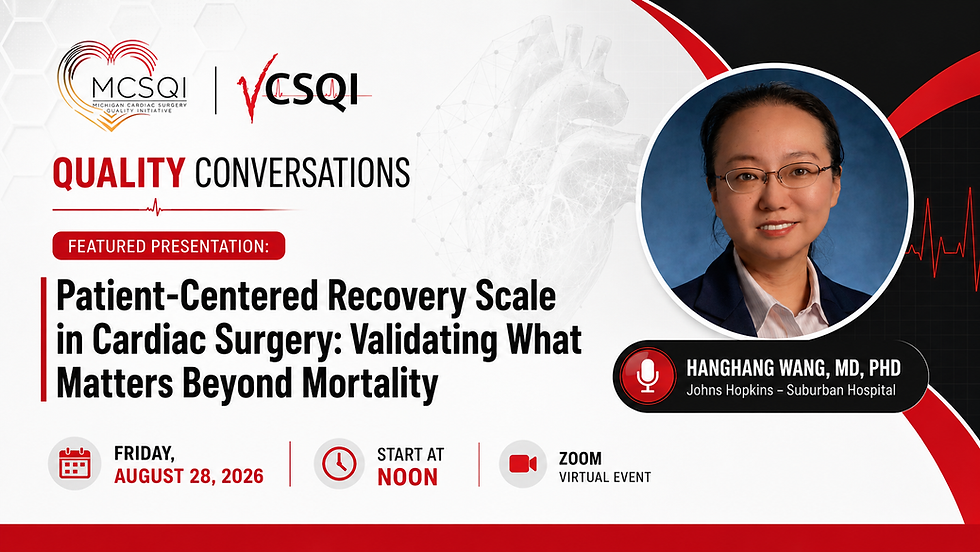
Visit https://www.vaheartattackcoalition.org/ to register for any of the following events:


Comments